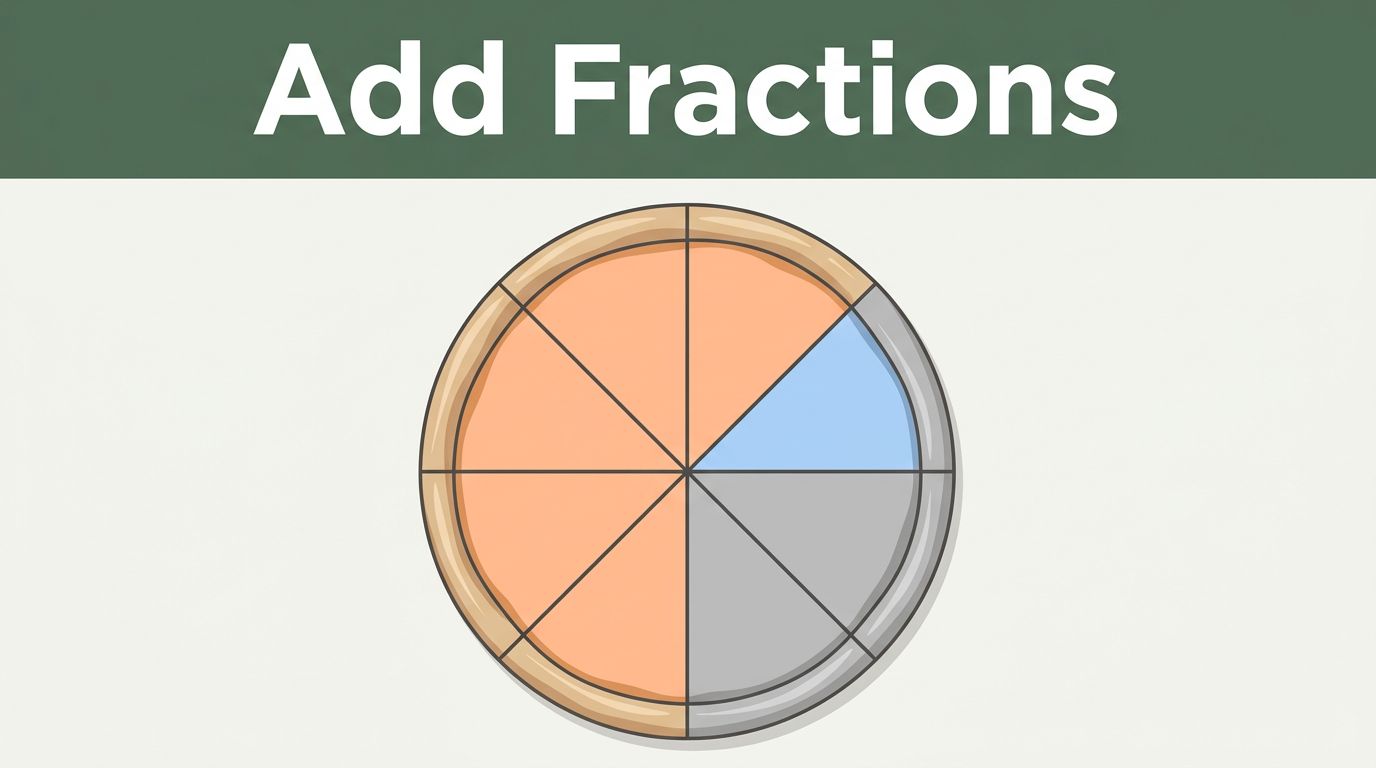
Ever tried splitting a pizza with friends? You order one with eight slices. One friend grabs five slices, another takes one. How much is left? That’s 5/8 + 1/8, a simple fraction add. Fractions pop up everywhere, from recipes to construction. They show parts of a whole: numerator on top, denominator below.
Many students stumble here. They mix up steps or skip simplifying. But you can master how to add and subtract fractions step by step. This guide breaks it down clearly. You’ll handle same denominators first, then different ones, mixed numbers, and pitfalls. Practice builds speed and confidence for homework or tests.
First, we start with basics. Then level up to tricky cases. By the end, fractions feel easy.
Master the Basics: Same Denominators First
When denominators match, adding or subtracting fractions gets simple. You only touch numerators. Keep the denominator put. Then simplify the result. This builds your foundation because most problems start here.
Think of shaded shapes. Imagine a rectangle split into eight parts. Shade five and one more. That’s six shaded out of eight. Simplify to three out of four.
Simplify by dividing top and bottom by their greatest common factor. For 6/8, divide by 2. You get 3/4.
Step-by-Step Addition
Follow these numbered steps for addition:
- Check denominators match. If yes, proceed.
- Add numerators only.
- Write sum over common denominator.
- Simplify if needed.
Take 5/8 + 1/8. Denominators match at 8. Add 5 + 1 = 6. So 6/8. Divide top and bottom by 2: 3/4.
Another: 3/10 + 4/10 = 7/10. No simplify needed.
Step-by-Step Subtraction
Subtraction works almost the same. Subtract numerators instead.
- Confirm matching denominators.
- Subtract numerators.
- Keep common denominator.
- Simplify.
Example: 7/12 – 5/12. 7 minus 5 is 2. So 2/12. Divide by 2: 1/6.
If numerator goes below zero, borrow from a whole, but that’s later. Here, results stay positive.
Try These Examples Yourself
Pause and solve these.
- 2/5 + 3/5 = ? (Answer: 1)
- 9/16 – 4/16 = ? (Answer: 5/16)
Check work. Did you simplify? Good job.
Level Up: Handle Different Denominators with Confidence
Different denominators need extra work. Find the least common denominator first. LCD is the smallest number both divide into evenly.
List multiples for small numbers. Or factor into primes for bigger ones. Once you have LCD, rewrite each fraction.
For example, 2/9 + 2/3. Multiples of 9: 9, 18. Of 3: 3, 6, 9. LCD is 9. Change 2/3 to 6/9. Now 2/9 + 6/9 = 8/9.
Real life? Share candies. Six kids get 1/6 each, nine get 1/9. Use LCD 18 to combine.
For more on quick tricks for finding the LCD, check this resource.
Finding the Least Common Denominator Quickly
Steps for multiples method:
- List multiples of first denominator.
- List for second.
- Pick smallest shared.
4 and 6: 4 (4,8,12), 6 (6,12,18). LCD 12.
Prime factors: 10=2×5, 15=3×5. LCD 2x3x5=30.
Practice: LCD of 8 and 12? 24.
Adding Fractions That Don’t Match
Full process:
- Find LCD.
- Multiply top and bottom of each to match LCD.
- Add numerators.
- Simplify.
1/4 + 1/6. LCD 12. 1/4=3/12, 1/6=2/12. 5/12.
Subtracting Mismatched Fractions
Same steps, subtract numerators.
1/6 – 1/9. LCD 18. 1/6=3/18, 1/9=2/18. 1/18.
Negative? Fine, means one is smaller.
Conquer Mixed Numbers Without the Stress
Mixed numbers mix wholes and fractions, like 2 1/4. Convert to improper first: multiply whole by denominator, add numerator. All over denominator. 2 1/4 = (2×4 +1)/4 = 9/4.
This method shines for different denominators. Add as regular fractions, convert back.
Same denominators? Add wholes separate, fractions separate.
Example: 2 1/4 + 1 3/4. Same denom 4. Wholes 2+1=3, fractions 1/4+3/4=1. Total 4.
For rules on adding mixed numbers, see this guide.
Subtraction may need borrowing. Convert if top fraction smaller.
Convert Mixed to Improper Fractions
Formula: (whole x denom + num) / denom.
2 3/5 = (2×5 +3)/5 = 13/5.
3 1/2 = (3×2 +1)/2 = 7/2.
Add and Subtract Mixed Numbers Step by Step
1 2/3 + 2 1/6. Different denom. LCD 6.
Convert: 1 2/3 = 1 4/6 = (1×6 +4)/6 = 10/6.
2 1/6 = 13/6.
10/6 + 13/6 = 23/6 = 3 5/6.
Subtract: 4 1/3 – 1 2/3. Same denom. Wholes 4-1=3, 1/3-2/3 borrow: 3 4/3 – 1 2/3 = 2 2/3.
Dodge These Common Mistakes and Get Pro Tips
Beginners often add denominators too. 1/2 + 1/3 is not 2/5. Always match first.
Forget simplifying? 4/8 stays 1/2.
Skip LCD for subtract? Wrong.
In 2026, apps help. Khan Academy offers free videos. Prodigy turns practice into games.
Pitfalls Every Beginner Hits
- Adding denominators: 1/3 + 1/4 ≠ 2/7. Use LCD 12: 4/12 + 3/12 = 7/12.
- No simplify: 6/8 = 3/4. Divide by 2.
- Wrong mixed convert: 2 3/4 ≠ 23/4. It’s 11/4.
- Ignore negatives in subtract.
For more common fraction mistakes, read this.
Tips to Make Fractions Fun and Easy
Draw pictures of pizzas. Shade parts.
Check by multiplying back: fraction x denom = parts of whole.
Use Photomath to scan and see steps.
Practice 10 minutes daily with Prodigy.
Play GeoGebra for visuals.
Ready to Tackle Any Fraction Problem
You now know how to add and subtract fractions step by step. Start with matching denominators. Find LCD for others. Convert mixed numbers. Avoid pitfalls like skipping simplify.
Mastery comes with practice. Try these:
- 3/10 + 4/10 = 7/10
- 5/6 – 1/3 = 1/2 (LCD 6: 5/6 – 2/6)
- 1/5 + 3/10 = 1/2 (LCD 10: 2/10 + 3/10)
- 2 1/2 – 1 1/4 = 1 1/4 (Convert: 5/2 – 5/4 = 10/4 – 5/4 = 5/4 = 1 1/4)
- 3 2/5 + 1 3/10 = ? (LCD 10: 3 4/10 + 1 3/10 = 4 7/10)
Solve now. Share answers in comments. Bookmark this for homework. Next, try multiplying fractions. You’ve got this.