
Picture this: you’re at the grocery store checkout. The total hits $47.63, and you need to add a 15% tip fast. You fumble for your phone calculator while the person behind you zips through it in their head and pays.
That moment stings, right? Yet mental math skills fix it. They sharpen your focus and memory, based on recent studies like one from Duke showing brain boosts in stress-handling areas. Plus, you save time daily and shine in school or jobs.
This post covers foundation tips, addition tricks, multiplication shortcuts, and fun practice. Stick with simple daily habits, and you’ll calculate confidently soon.
Build a Strong Foundation for All Your Mental Math
Strong basics make every math task smoother. You start with number sense, so big problems feel small. Without it, you guess; with it, you flow.
Take place value. Numbers break into hundreds, tens, and ones. So 278 plus 367 works like this: 200 plus 300 equals 500. Then 70 plus 60 makes 130. Finally, 8 plus 7 is 15. Add them up: 645. See how chunks simplify?
Do short drills daily. Repeat times tables through addition, like 4 times 3 as 3 plus 3 plus 3 plus 3. Memorize up to 12×12 over time. Consistency builds speed, so practice five minutes each morning.
Recent cognitive studies back this. Mental training lights up brain spots for better focus and emotional health, per Duke and Stanford research. Your brain gets sharper overall.
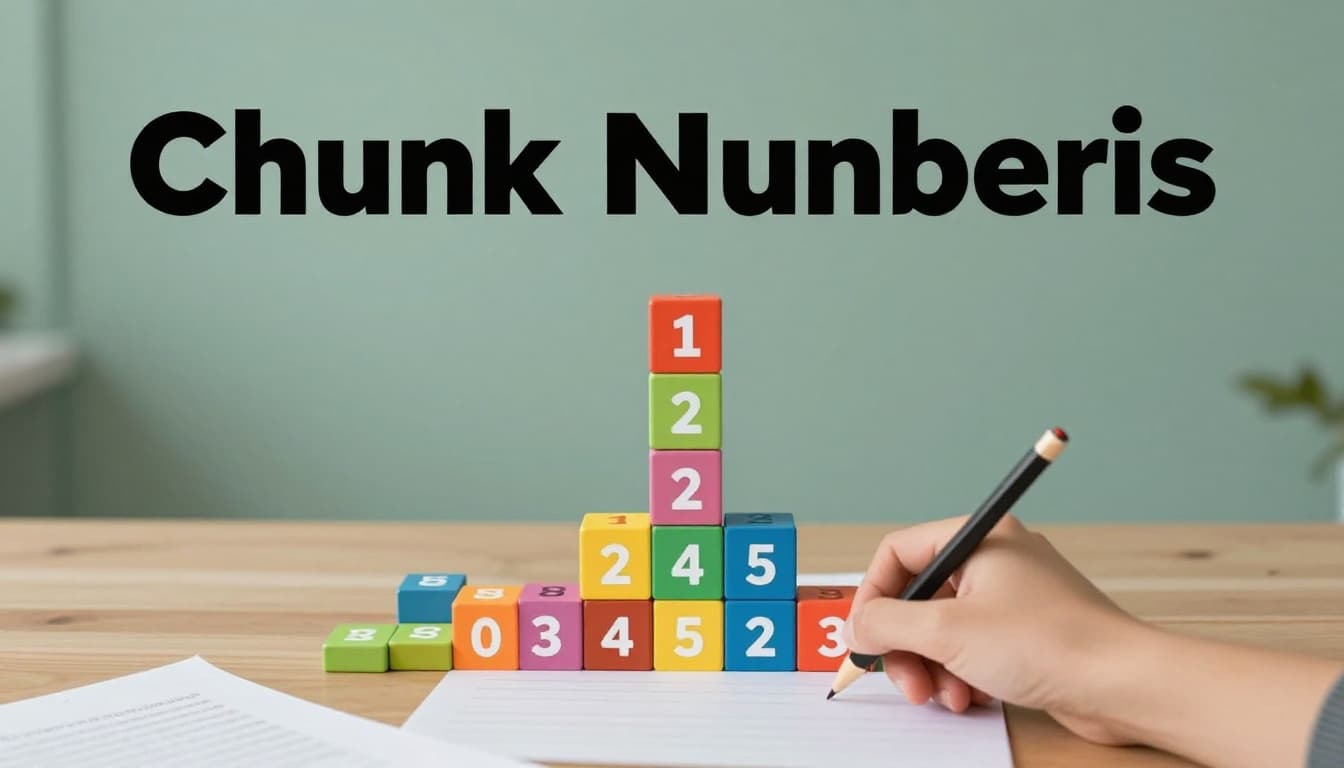
Chunk Numbers by Place Value for Quick Wins
Chunking cuts overload. For addition, split by place. Try 456 plus 278. Hundreds first: 400 plus 200 equals 600. Tens: 50 plus 70 is 120. Ones: 6 plus 8 makes 14. Total: 600 plus 120 is 720, plus 14 equals 734.
Now multiplication. 14 times 3 breaks to 10 times 3 (30) plus 4 times 3 (12). That’s 42. Easy, right?
Practice these: 189 plus 456. Chunks: 100+400=500, 80+50=130, 9+6=15. Sum: 645. Or 23 times 4: 20×4=80, 3×4=12, total 92.
This method builds confidence fast because you handle small parts.
Lock in Times Tables with Fun Mnemonics
Mnemonics stick facts in your mind. For 4 times 4 equals 16, think “at 4×4, you’re old enough to drive a 4×4 truck.” Silly stories work best.
Use flashcards five minutes daily. Front: 7×8. Back: 56, with a rhyme like “7 ate 8, but it’s 56.” Repeat until automatic.
Check multiplication mnemonics collection for more ideas. They turn boring drills into quick wins, so recall speeds up naturally.
Master Addition and Subtraction in Seconds
Now apply basics to add and subtract fast. Left-to-right beats right-to-left because you tackle big numbers first. Compensation adjusts for easy rounds.
These shine in shopping or tips. No more pauses; you respond quick.
For example, 456 plus 789. Start hundreds: 400 plus 700 is 1,100. Then 50 plus 80 equals 130. 6 plus 9 is 15. Total: 1,100 plus 130 is 1,230, plus 15 makes 1,245.
Subtraction uses similar steps. Practice builds the habit.
Add from Left to Right Like a Pro
Scan left first. 367 plus 584: 300 plus 500 equals 800. 60 plus 80 is 140. 7 plus 4 is 11. Now 800 plus 140 makes 940, plus 11 is 951.
For bigger, carry mentally. 999 plus 456: 900 plus 400 is 1,300. 90 plus 50 is 140 (carries to thousands). 9 plus 6 is 15. Adjust: 1,300 plus 140 is 1,440, plus 15 equals 1,455.
Time yourself on five problems daily. It sharpens speed, like pros do.
Subtraction borrows same way. 1,000 minus 498: think 502 because 2 plus 498 makes 500, then to 1,000.
Use Rounding and Adjusting for Subtraction
Round for ease. 98 minus 24: round 98 to 100, subtract 24 equals 76, then subtract 2 more for 74.
Or division: 98 divided by 4. 100 divided by 4 is 25; subtract 2 divided by 4 (0.5) gets 24.5.
Perfect for change. $1.87 minus $1.50: round to $2 minus $1.50 is $0.50, adjust down 0.13 for $0.37. Quick and accurate.
Unlock Multiplication and Division Shortcuts
Shift to tougher ops. Proven tricks handle big numbers without paper. Double-and-halve shrinks them; special rules speed 5s, 9s, 11s.
Estimation fits division. You get fast answers close enough for most needs.
These cut calc reliance, so daily math feels simple.
Quick Tricks for 5s, 9s, and 11s
Times 5: halve times 10. 7×5: 70 halved is 35.
9s: times 10 minus the number. 7×9: 70 minus 7 equals 63. Or 12×9: 120 minus 12 is 108.
11s for two-digits: add digits, insert between. 34×11: 3+4=7, so 374. Works because 30×11=330, 4×11=44, total 374.
Examples: 9×8=72 (90-8). 23×11: 2+3=5, 253. Fingers help 9s too: hold up fingers, fold ninth, count left and right.
Double and Halve for Tough Multiplications
Even numbers halve easy. 33×48: halve 48 to 24, double 33 to 66. Now 66×24: halve 24 to 12, double 66 to 132. Then 132×12: halve 12 to 6, double 132 to 264. Finally 264×6=1,584.
Try 16×35. Halve 16 to 8, double 35 to 70: 70×8=560. Halve 8 to 4, double 70 to 140: 140×4=560. Same result.
This pairs well with chunking from basics.
Round Smart for Fast Division
Estimate first. 376 divided by 7: 350 divided by 7 is 50. Remainder 26 divided by 7 is about 3.7, so 53.7. Check: 7×53=371, close.
For discounts: 20% off $85 is 85 divided by 5 equals 17. Or 15% off $60: 10% is 6, half is 3, total 9.
Practice rounds you up quick.
Practice with Games and Real-Life Challenges
Tricks stick through play. Games make it fun; daily uses build habit. Track progress weekly to see gains.
Competitions motivate too. Join online ones for push.

Try These Addictive Math Games at Home
Math Facts Bingo: Write answers on cards. Call equations like “6×7.” Mark 42. First full row wins. Solo: time covers.
Stand Up Sit Down: Say target, like sums to 20. Stand if right, sit if wrong. Family rotates caller.
Cover-Copy-Compare: Write 7×8=56. Cover, recall. Check. Ten minutes daily works solo or group.
Setup takes two minutes; play boosts recall fast.
Apply Skills Daily and Join Competitions
Use in life: 15% off $60 is 9. Currency: $1.25 times 4 equals 5. Conversions: 5km to miles, about 3.
Apps help. Try Zetamac for arithmetic practice, free and quick.
For challenge, enter Mental Math World Cup 2026. Register by May 31; qualifier August 1-5. Ages 6+, with Zen Challenge option. Past events drew thousands; top scorers finale later.
Weekly quizzes track speed. Note problems solved per minute.
Studies confirm practice pays. Mental math cuts dementia risk 20% long-term, per Johns Hopkins 2026 data.
Build basics, master tricks, practice daily. That’s the path.
Pick one trick now, like chunking. Track over 30 days; share your wins in comments. You’ll handle math like a champ, no calculator needed. What skill will you try first?