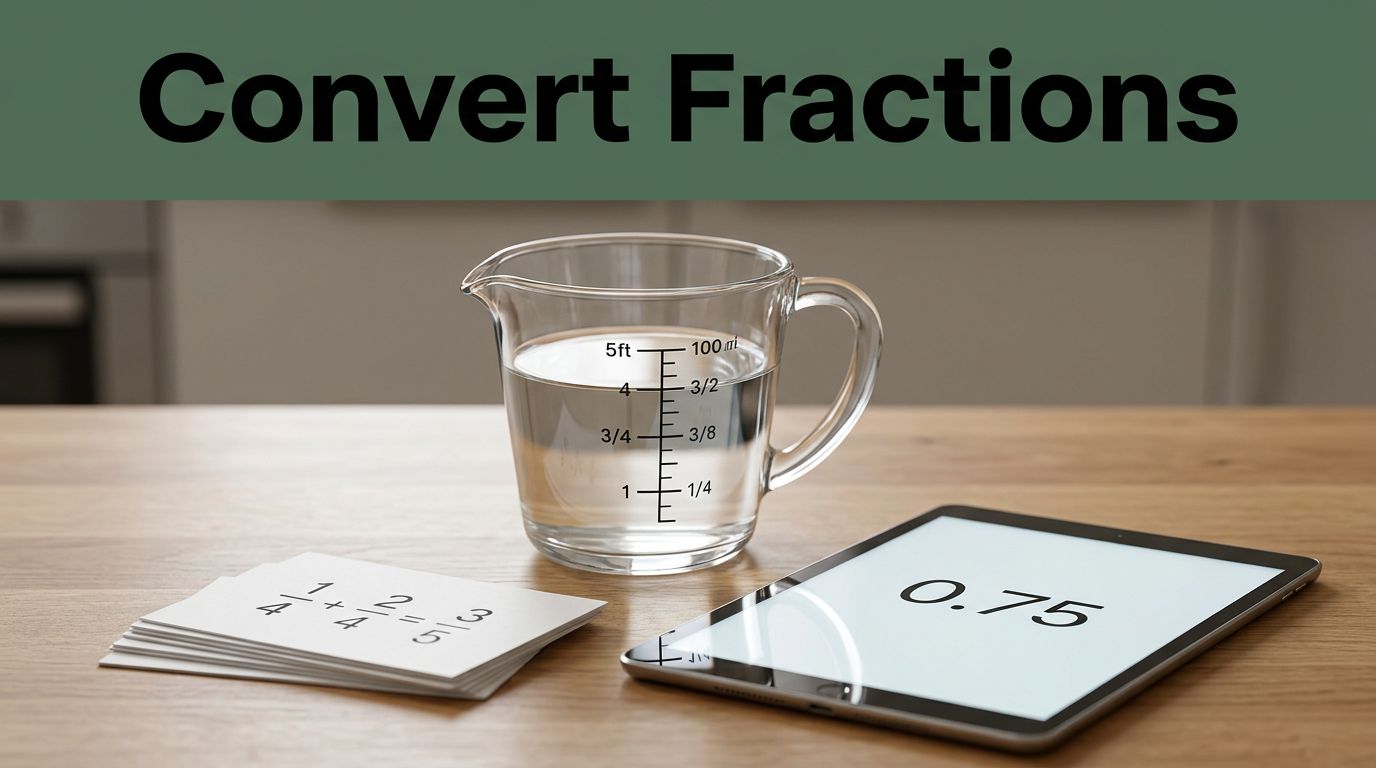
You grab a recipe for chocolate chip cookies. It calls for 3/4 cup of flour. But your measuring cup shows decimals only. You guess and end up with flat pancakes. Sound familiar? Fractions pop up everywhere, from cooking to shopping discounts. They trip up budgets and DIY projects too.
Mastering fraction to decimal conversion fixes that. You’ll handle measurements, sales tax, or sewing patterns with ease. This guide breaks it down simply. First, learn terminating and repeating decimals. Then master long division for any fraction. Pick up shortcuts for quick wins. Spot mistakes before they happen. Finally, practice with tools that fit 2026 life.
No more second-guessing. You’ll see examples like 1/2 = 0.5. Follow these steps, and confusion vanishes. Even in April 2026, with apps everywhere, doing it by hand builds real skill. Ready to start?
Spot the Difference: Terminating vs Repeating Decimals
Decimals from fractions fall into two types. Terminating decimals end after a few places. They stop because the remainder hits zero. Repeating decimals loop forever. A bar shows the repeat part.
Look at denominators for clues. Ones with factors of 2 or 5 only make terminating decimals. For example, 1/2 uses 2, so 0.5 ends clean. 1/4 factors as 2×2, equals 0.25. 1/5 gives 0.2. 1/8, or 2^3, hits 0.125. 3/4 becomes 0.75. These stay neat.
Repeating decimals come from other denominators, like 3. 1/3 equals 0.333… The 3 repeats. 2/3 is 0.666… Division shows the loop when remainders repeat.
Why care? You avoid cutting short on repeats. In money, dollars terminate because of base 10. Measurements might repeat, so know when.

Here’s a quick table of common ones:
| Fraction | Decimal | Type |
|---|---|---|
| 1/2 | 0.5 | Terminating |
| 1/4 | 0.25 | Terminating |
| 1/5 | 0.2 | Terminating |
| 1/8 | 0.125 | Terminating |
| 3/4 | 0.75 | Terminating |
| 1/3 | 0.333… | Repeating |
| 2/3 | 0.666… | Repeating |
Quick Chart of Everyday Fractions
Print a full fraction to decimal chart for your kitchen or desk. It lists up to 1/16. Great for 1/2 through 3/4 at a glance. Still, not every fraction fits. Use division for others.
Long Division Mastery: Convert Any Fraction Step by Step
Long division works for every fraction. Divide numerator by denominator. That’s the core.
Set up like regular division. Take 3/4. Write 3 divided by 4. Since 4 doesn’t go into 3, add a decimal point and zero. Make it 3.0 divided by 4.
4 goes into 30 seven times. 4×7=28. Subtract. Remainder 2. Bring down zero for 20. 4 goes 5 times exactly. 4×5=20. Remainder zero. So 3/4=0.75.
Now try 5/8. Set up 5 divided by 8. Add decimal and zeros: 5.000.
8 into 50 goes 6 times. 8×6=48. Subtract. Remainder 2. Bring down zero: 20.
8 into 20 goes 2 times. 8×2=16. Remainder 4. Bring down zero: 40.
8 into 40 goes 5 times. 8×5=40. Remainder 0. Result: 0.625.

Use graph paper. It keeps numbers straight. Skip calculators at first. Practice builds speed.
For 1/3, 1 divided by 3. 10/3=3 rem1. 10/3=3 rem1. Loop starts. Write 0.333… with bar over 3.
Check your work. Multiply decimal by denominator. Should equal numerator. 0.625 x 8 =5. Perfect.
Handle Mixed Numbers and Improper Fractions Easily
Mixed numbers add whole and fraction parts. Take 2 3/5. Convert 3/5 first. 3 divided by 5=0.6. Add 2. Gets 2.6.
Improper fractions divide straight. 5/4. 5 divided by 4. 4 into 50=12 rem2? Wait, 5.0 /4. 4 into 50=1 (wait no: 4 into 5=1 rem1, 10/4=2 rem2, 20/4=5 rem0. So 1.25.
Shortcut for Simple Fractions: Powers of 10 Trick
Some fractions convert fast. Denominators like 2,4,5,8,10 work well. Multiply top and bottom to reach 10,100,or 1000. Drop the decimal.
3/5. Multiply by 2/2. Becomes 6/10=0.6. Easy.
1/8 needs 125/125. 1×125=125, 8×125=1000. So 125/1000=0.125.
1/4 x 25/25=25/100=0.25.
These shine for mental math. But skip for 3,6,7,9. They repeat.
Pair with your chart. Saves time on recipes.

Steer Clear of Traps: Common Mistakes and Smart Checks
Errors sneak in easy. Many forget the decimal point. Or swap numerator and denominator. 4/3 becomes 3/4 by mistake.
Others stop too soon on repeats. 1/3 looks like 0.3, but it’s 0.333…
No zeros added leads to wrong places. Always tack on after decimal.
From student slips, adding numerators direct hurts too, but that’s fractions. Here, main issue stays division setup.
Fixes help. Divide top by bottom always. Add zeros until zero remainder or repeat shows. Then verify.
Practice halves, quarters, fifths first. Builds habit.

See more common fraction mistakes to dodge.
Pro Verification Tricks That Build Confidence
Multiply back. Or use apps after hand work. Sites like Math is Fun offer worksheets.
Level Up with Practice Tips, Tools, and Real-World Wins
Start simple. Use graph paper. Note patterns in repeats.
In 2026, grab Khan Academy videos. They show 7/8 step-by-step. Updated exercises match school.
Watch Math Antics on YouTube. Six minutes covers all.
Apps like Photomath scan problems. Mathos AI gives steps. Check K5 Learning worksheets too.
Try these: 7/8=0.875. 1/6=0.1666…
Do five minutes daily. Soon recipes and budgets click.

Long division rules them all. Shortcuts speed easy ones. Know types and traps.
Grab that chart. Convert three fractions now: 5/6, 3/8, 1/7. Share your wins below. Math powers everyday choices. No more recipe disasters. You’ve got this.